
Description
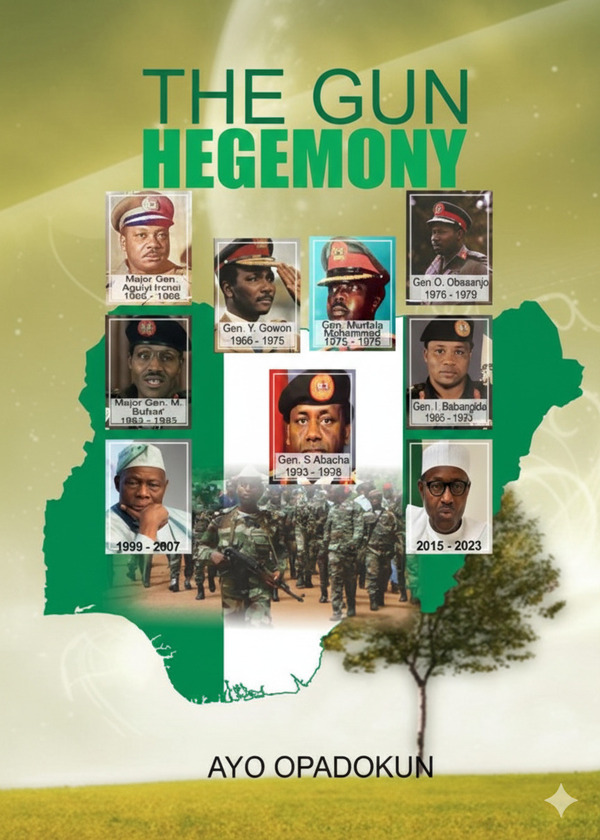
The Gun Hegemony is the Composite exposition of the impact on human existence that the invention of the gun and its transformation has had from the 9th to the 12th Century. In particular, it was by their superior gun power that the various European countries embarked on colonialism and the conquest of settlements and inhabitants of geopolitical spaces that did not have early access to the strategic guns and ammunition.
The book explains that the geopolitical space now called Nigeria, at its Amalgamation in 1914, was one of those settlements captured by imperialists after the Berlin Conference on the Partition of Africa, 1884-1885. The book restates that Nigeria is a creation of the gun, and the country’s growth and development have been arrested and stunted by the colonialists’ established “Nigerian Army” (for the conquest, subjugation and domination of its subjects) as the new custodian of the gun with which they tolerated the Nigerian civil leadership for barely five years. The Military violently overran the “bloody civilians” on January 15, 1966. From the Military incursion into Nigeria’s political leadership, that institution has run Nigeria from 1966-1979 9(13 years), 1983-1999(16 years), i.e. 29 years in uniform and 1999-2007(eight years) and 1915-2023 (eight years), i.e. 16 years in civilian wear. This makes a total of 45 years of Military rule in the 66 years of Nigeria’s Independence.
The consequence of the Military overrunning the political leadership of Nigeria has led the soldiers with their guns to perpetually suspend and abrogate the painfully negotiated Independence Federal Constitution that recognised the heterogeneous nature of the British –created Nigeria, populated by people of different cultures, traditions, languages, religions, artefacts, folklores, mores and morals. The very potent nature of the Federal Constitution is the recognition and guaranty of independence for all the different federating unites i.e. unity in diversity. It was this uniqueness that was abrogated and substituted with unitarist and centralist decrees that have resulted in unjust, inequitable, unfair, and sectional public policies to date.
The book highlights the telling impact of Military dictatorship not just on Nigeria’s socio-political, socio-economic and infrastructural sectors, but on the Military institution itself.




Reviews
There are no reviews yet.