When former President Olusegun Obasanjo speaks about African history, he does not just speak as a politician — he speaks as someone who has lived, studied, and witnessed the consequences of forgetting where we come from.
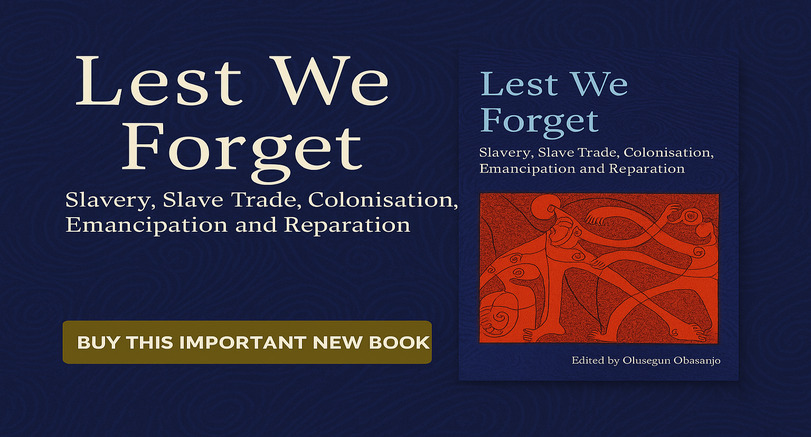
His new book, “Lest We Forget: Slavery, Slave Trade, Colonisation, Emancipation and Reparation”, is not just a history book.
It is a reminder, a warning, and a call to action for Africans everywhere.
Unveiled during his 88th birthday celebration at the Olusegun Obasanjo Presidential Library in Abeokuta, the book brings together leaders, intellectuals, governors, traditional rulers, and scholars — proving how important and timely this message is.
And in this blog post, you’ll discover exactly why this book is a must-read for every Nigerian and African.
“If We Forget Our History, We Will Go Back Into Slavery” — Obasanjo
One of the most striking statements Obasanjo made at the book presentation was this:
“If we forget slavery, not only will we continue to suffer its effects, we will be re-enslaved again.”
This is not an exaggeration.
According to him:
- Africans still suffer from the psychological and structural wounds of slavery.
- Over two centuries later, the continent has not fully recovered.
- Forgetting our past makes us vulnerable to modern forms of exploitation, manipulation and oppression.
For many Nigerians, slavery feels like something distant — something that happened long ago.
Obasanjo’s book reminds us that its effects are still here:
- economic inequality,
- cultural erosion,
- identity loss,
- and the mindset of inferiority created by centuries of dehumanisation.
This book forces us to confront these truths.
Transatlantic or Trans-Sahara, Slavery Had the Same Devastating Effect
Obasanjo does not limit the discussion to one type of slavery.
He states clearly:
“Whether transatlantic or trans-Sahara, slavery had the same effect on us.”
That effect includes:
- loss of millions of African lives,
- destruction of African kingdoms,
- disruption of social systems,
- weakening of economies,
- and the foundation for colonial domination.
In other words, slavery was not just physical — it was economic, cultural, psychological, and generational.
And the book explains how all these layers still shape Africa today.
Why Africa Still Struggles: The Invisible ‘Residue of Slavery’
One of the most insightful parts of the book comes from a lecture delivered by Professor Eghosa Osaghae, Director-General of the Nigerian Institute of International Affairs.
He revealed an alarming fact:
Over 12.5 million people in Africa today are trapped in modern forms of slavery.
That is 60% of global slavery.
It shows that slavery never ended — it only changed form.
Obasanjo calls this the “residue of slavery”, a leftover system of:
- exploitation,
- foreign control,
- dependence on Western models,
- economic manipulation,
- cultural displacement,
- and weakened national identity.
The book argues that Africa cannot move forward unless it breaks free from these psychological and structural chains.
Colonisation: The Second Chain Around Africa’s Neck
While slavery weakened Africa, colonialism built on that weakness.
Obasanjo’s book explains:
- how colonial rule restructured African societies for exploitation,
- how local identities were erased or downgraded,
- how natural resources were extracted without development,
- and how Africa was moulded to serve other parts of the world.
Professor Osaghae adds:
“Africa needs another independence — a meaningful decolonisation.”
This means:
- reclaiming African identity,
- strengthening indigenous languages,
- promoting African knowledge systems,
- and developing Africa on African terms.
The book calls this the true emancipation Africans have not yet achieved.
Emancipation, Reparations and the Need for a Re-Awakened Africa
Lest We Forget does not only look at the past — it demands a better future.
Obasanjo’s message is clear:
- Africa must understand that its history was manipulated.
- Africans must rediscover their dignity and strength.
- The continent must demand reparations and fairness.
- And above all, Africa must learn — not to repeat its past.
He emphasises identity, even jokingly declaring he preferred to be addressed by his Yoruba names:
Olusegun Aremu Okikiola Obasanjo.
This symbolic moment reflects a deeper message in the book:
✨ Africa must take back its name, its mind, and its future.
Why You Should Read This Book
This book is for you if:
- you want to understand the true history of Africa
- you want to know why Africa still struggles economically
- you’re passionate about African culture and heritage
- you want to break free from the mental effects of colonisation
- you want your children to know where they come from
- you believe Africa’s future depends on its memory of the past
Obasanjo delivers the message boldly and with deep personal insight.
He wants Africans to:
- remember,
- reflect,
- reclaim,
- rebuild,
- and rise.
And this book provides the perfect foundation to begin that journey.
🛒 Ready to Get Your Copy?
You can buy “Lest We Forget: Slavery, Slave Trade, Colonisation, Emancipation and Reparation” directly from our store.
👉 order your copy now @
(https://sunshinebookseller.com/product/lest-we-forget-slavery-slave-trade-emancipation-and-reparation-quantity/)
This is more than a book — it is a powerful educational tool, a reminder of our heritage, and a guide for Africa’s future.
Frequently Asked Questions
Is Lest We Forget a history book?
Yes, but it is written with emotion, warnings, and lessons for modern Africa.
Does the book talk about modern slavery?
Yes — it explains how millions of Africans today are still affected by new forms of slavery.
Is the book suitable for students?
Absolutely. It is perfect for school research, university studies, and African history exams.
Is it political?
No — it is more cultural and historical, though it touches on leadership and identity.
Should I buy the book?
Yes. If you care about Africa’s past and future, you will find this book eye-opening and valuable.