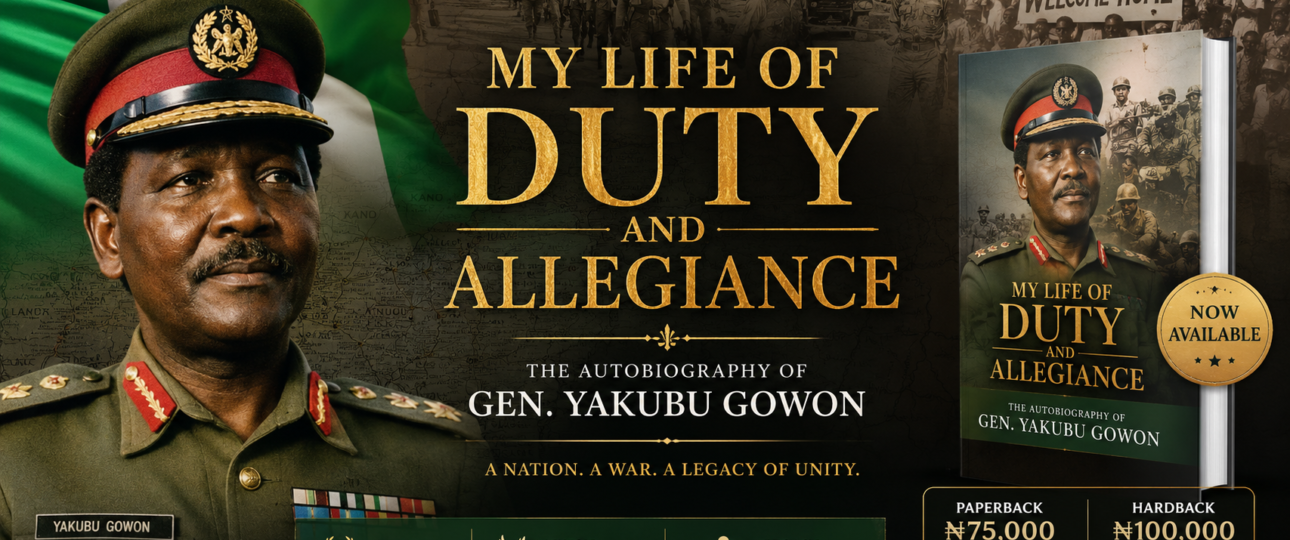
Nigeria’s history is incomplete without the name Yakubu Gowon.
For millions of Nigerians, he represents one of the most difficult, controversial, and transformative periods in the nation’s journey — the years of military rule, civil war, reconstruction, and the long struggle for national unity.
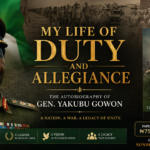
Now, decades after leading Nigeria through one of the darkest chapters in its history, General Gowon offers a deeply personal and historically significant reflection in his memoir, “My Life of Duty and Allegiance.”
This is not merely another political autobiography.
It is a first-hand account of power, war, sacrifice, leadership under extraordinary pressure, faith, reconciliation, and service to a nation still searching for unity.
For historians, political observers, students, journalists, military analysts, and Nigerians at home and abroad, this memoir stands as one of the most important Nigerian political books of the modern era.
Buy the Book
Paperback — ₦75,000
Hardback — ₦100,000
Available now at:
Sunshine Bookseller Official Store
Why Yakubu Gowon’s Memoir Matters in Nigerian History
Nigeria has produced many political memoirs, but only a few carry the historical weight of a leader who governed during an existential national crisis.
General Gowon became Nigeria’s Head of State in 1966 at only 31 years old, following a period of political instability, ethnic tension, and military upheaval. His leadership coincided with the events that would eventually lead to the Nigerian Civil War between 1967 and 1970.
The war remains one of the most emotionally charged periods in Nigerian history.
Families were divided. Communities were destroyed. Millions suffered displacement, starvation, trauma, and loss. The political scars of that era continue to influence conversations around ethnicity, federalism, governance, and national identity today.
What makes My Life of Duty and Allegiance especially powerful is that it offers readers access to the mind of the man at the center of these historic events.
Rather than relying solely on second-hand accounts, archival interpretation, or political speculation, readers hear directly from Gowon himself — his fears, convictions, decisions, regrets, pressures, and hopes for Nigeria.
That alone makes this memoir historically indispensable.
The Early Life of Yakubu Gowon
From Humble Beginnings to National Leadership
One of the most compelling aspects of the memoir is its exploration of Gowon’s early life.
Born in Northern Nigeria to missionary parents, Gowon’s upbringing was deeply shaped by discipline, education, faith, and service. Long before politics and military leadership defined his public identity, he was simply a young Nigerian navigating a rapidly changing colonial and post-colonial society.
The memoir traces:
- His childhood experiences
- His educational journey
- His entry into military service
- His professional military development
- The internal dynamics of the Nigerian Army during the First Republic
These sections humanize a figure often viewed only through the lens of state power and military history.
Readers begin to understand that leaders are not born in isolation. They are shaped by culture, conflict, institutions, upbringing, and historical circumstance.
Understanding the Nigerian Civil War Through Gowon’s Eyes
A First-Hand Account of Nigeria’s Most Painful Conflict
No discussion of this memoir can avoid the Nigerian Civil War.
For many Nigerians born decades after the war, the conflict often exists as fragmented history — something briefly mentioned in classrooms but rarely explored with depth and emotional honesty.
This book changes that.
Gowon provides insight into:
- The political instability after the coups of 1966
- Rising ethnic tensions
- The collapse of trust between regions
- Secession and the declaration of Biafra
- Military strategy and national security concerns
- Humanitarian consequences of war
- International diplomatic pressures
- Post-war reconciliation efforts
Importantly, the memoir does not merely recount military operations. It explores the immense psychological and moral burden of leadership during wartime.
Readers witness the impossible decisions leaders face when the survival of a nation appears uncertain.
“No Victor, No Vanquished”
Perhaps one of the most enduring phrases associated with Gowon’s legacy is:
“No Victor, No Vanquished.”
That declaration after the civil war became one of the defining moments of Nigerian reconciliation efforts.
In My Life of Duty and Allegiance, readers gain deeper context into the philosophy behind those words.
Rather than embracing vengeance or triumphalism, Gowon sought national reintegration — an effort that would shape post-war Nigeria for decades.
Even today, that message remains profoundly relevant.
In an era of rising polarization, ethnic suspicion, and political fragmentation, Gowon’s emphasis on unity, healing, and nationhood feels remarkably contemporary.
Leadership Under Pressure: Lessons from Gowon’s Presidency
Leadership Is Tested Most During Crisis
One of the strongest themes throughout the memoir is leadership under extraordinary pressure.
Gowon assumed office during one of Nigeria’s most unstable periods. The country faced:
- Political uncertainty
- Military unrest
- Ethnic division
- International scrutiny
- Economic instability
- Armed conflict
Yet the memoir reveals a leader attempting to balance power with restraint, patriotism with pragmatism, and military authority with national responsibility.
Key Leadership Lessons from the Memoir
1. Leadership Requires Emotional Discipline
The memoir demonstrates how emotional reactions during crises can shape national outcomes.
Gowon repeatedly reflects on the need for patience, consultation, and careful decision-making, especially during moments of intense pressure.
2. National Unity Requires Sacrifice
One of the central messages of the book is that unity is not automatic.
It must be defended, nurtured, negotiated, and sometimes painfully rebuilt.
3. Faith Can Shape Public Leadership
Faith plays a major role throughout Gowon’s life story.
Readers see how spirituality influenced:
- His decision-making
- His understanding of service
- His approach to reconciliation
- His post-government peace initiatives
4. Power Is Temporary, Legacy Is Permanent
The memoir reflects a recurring awareness that political power eventually fades, but the consequences of leadership endure across generations.
This reflective tone gives the book unusual maturity and depth.
Why This Memoir Matters to Young Nigerians Today
A Generation Searching for Historical Understanding
Many young Nigerians today feel disconnected from the nation’s history.
They inherit political tensions without fully understanding their origins.
They hear references to:
- The civil war
- Military rule
- National unity
- Federal character
- Ethnic politics
But often lack access to detailed, accessible, first-hand historical accounts.
That is why this memoir is essential reading.
It bridges the gap between past and present.
It helps younger generations understand:
- How Nigeria evolved politically
- Why certain national tensions persist
- How leadership decisions shape societies
- Why reconciliation remains important
History is not merely about the past. It explains the present.
And few books illuminate Nigeria’s political evolution as powerfully as this one.
Comparing Gowon’s Memoir with Other Famous Nigerian Political Memoirs
Nigeria has produced several influential autobiographies and political reflections.
However, My Life of Duty and Allegiance occupies a uniquely important position because of its proximity to the Nigerian Civil War and the scale of national events it addresses.
Compared with Obafemi Awolowo’s Writings
Obafemi Awolowo wrote extensively about governance, federalism, and national development.
While Awolowo’s works are intellectually rigorous and politically visionary, Gowon’s memoir offers the perspective of executive wartime leadership.
Together, both provide complementary perspectives on Nigerian nationhood.
Compared with Olusegun Obasanjo’s Memoirs
Olusegun Obasanjo is known for highly detailed political and military reflections.
Yet Gowon’s memoir differs in tone.
It is more reflective, restrained, spiritual, and reconciliation-focused.
Compared with Ibrahim Babangida’s Political Reflections
Ibrahim Babangida often writes from the perspective of political strategy and statecraft.
Gowon’s memoir places stronger emphasis on national healing, moral responsibility, and collective memory.
The Emotional Weight of National Memory
More Than Politics
One reason this memoir resonates so deeply is that it is not simply about politics.
It is about human consequences.
Readers encounter:
- Loss
- Duty
- Fear
- Hope
- Responsibility
- National identity
- Forgiveness
- Service
These themes elevate the memoir beyond political literature.
It becomes a meditation on what it means to lead a fragile nation through crisis.
Why Historians and Researchers Should Read This Book
For scholars and researchers, My Life of Duty and Allegiance represents a valuable primary-source historical document.
The memoir contributes to:
- Nigerian political history
- African military history
- Civil War Studies
- Post-conflict reconciliation studies
- Leadership analysis
- Post-colonial African governance research
Universities, libraries, policy institutes, journalists, and historians will find the book especially valuable for contextual understanding and historical interpretation.
Why Nigerians in the Diaspora Will Find This Memoir Powerful
For many Nigerians abroad, national history becomes emotionally distant over time.
Yet identity remains deeply connected to homeland memory.
This memoir provides diaspora readers with:
- Historical grounding
- Political context
- Cultural reflection
- Understanding of Nigeria’s evolution
- Insight into national resilience
It reconnects readers with the emotional and political foundations of modern Nigeria.
The Book as a Collector’s Item
Given General Gowon’s historic significance, this memoir is also likely to become an important collector’s item among:
- Political history collectors
- Libraries
- Universities
- Researchers
- African studies departments
- Military historians
- Serious book collectors
The hardback edition, in particular, carries long-term archival and collectible value.
Why Sunshine Bookseller Is the Best Place to Buy Nigerian Political Books
For readers searching for authoritative Nigerian political literature, Sunshine Bookseller has become one of Nigeria’s trusted destinations for:
- Political memoirs
- Historical books
- Biographies
- African history titles
- Rare Nigerian books
- Academic materials
The store continues to build a strong reputation among serious readers, researchers, scholars, and collectors seeking high-quality Nigerian literary and historical works.
Order “My Life of Duty and Allegiance” Today
Buy the Paperback or Hardback Edition Here
Paperback — ₦75,000
Hardback — ₦100,000
Why Every Nigerian Should Read This Memoir
Because Nations Must Remember
A country that forgets its history risks repeating its mistakes.
Nigeria continues to wrestle with:
- Division
- Distrust
- Leadership crises
- Questions of national identity
Books like My Life of Duty and Allegiance help preserve historical memory and encourage thoughtful national reflection.
Whether readers agree with every decision made during Gowon’s administration is ultimately secondary.
What matters is understanding.
Understanding history.
Understanding leadership.
Understanding conflict.
Understanding reconciliation.
Understanding Nigeria itself.
That is the enduring value of this memoir.
Frequently Asked Questions (FAQ)
What is “My Life of Duty and Allegiance” about?
My Life of Duty and Allegiance is the autobiography of General Yakubu Gowon, former Nigerian Head of State. The memoir explores his childhood, military career, leadership during the Nigerian Civil War, national unity efforts, and post-government peacebuilding activities.
Where can I buy Yakubu Gowon’s memoir?
You can purchase the memoir from:
Sunshine Bookseller Official Product Page
How much is Yakubu Gowon’s autobiography?
Paperback edition: ₦75,000
Hardback edition: ₦100,000
Why is Yakubu Gowon important in Nigerian history?
Yakubu Gowon led Nigeria during the Nigerian Civil War from 1967 to 1970 and played a major role in post-war reconciliation and national rebuilding.
Is this book good for researchers and students?
Yes. The memoir is highly valuable for:
- Historians
- Political science students
- Journalists
- Researchers
- Military historians
- African studies scholars
What makes this memoir different from other Nigerian political books?
Unlike many political memoirs, Gowon’s autobiography combines:
- Wartime leadership insight
- Personal reflection
- National reconciliation themes
- Faith and service
- Historical documentation
There are books that entertain.
There are books that inform.
And then there are books that become part of national memory.
My Life of Duty and Allegiance belongs to the last category.
It is not merely the story of a man.
It is the story of a nation under pressure, a leader carrying enormous responsibility, and the enduring search for unity in one of Africa’s most complex democracies.
For anyone seeking to understand Nigeria beyond headlines and political slogans, this memoir is essential reading.
Order your copy today from:
Sunshine Bookseller